Behavioral or Contextual Ads? Choose the Right Strategy in 2025

Digital ad targeting is changing fast. The phase-out of third-party cookies, tighter privacy laws, and growing consumer concerns are forcing advertisers to rethink strategy.
Currently, there are two main strategies. Behavioral targeting uses past actions and consumer behavior, while contextual targeting aligns ads with website content and keywords.
For marketers and advertisers, the challenge is to know when and how to use each to maximize ROI.
This article examines the evolution of targeting, compares behavioral and contextual advertising, and explains how to use each approach effectively.
How Ad Targeting Changed Over Time
Ad targeting, especially in digital advertising, isn’t what it used to be in the early days or even five years back. It started with a focus on broad-scope methods like banner ads and search advertising, where marketers bid for keywords, but without granular audience targeting or personalization.
The real transformation began with behavioral targeting, where marketers used cookies and browsing signals to reach individuals based on consumer behavior. A 2010 study conducted on behavioral targeted ads found that they are twice as effective as generic ads.
As this infrastructure matured, programmatic advertising platforms and demand-side platforms (DSPs) became standard tools for advertisers. These offered real-time control over ad placements, automated bidding, and refined audience segment targeting.
Today, ad targeting is again dramatically changing, mainly because of privacy concerns and regulations. Many consumers and regulators began to see third-party cookies as invasive of user privacy. Regulations like the European Union’s General Data Protection Regulation (GDPR) and California Consumer Protection Act (CCPA) allow users to opt out of tracking, which makes behavioral targeting challenging.
This increasingly tough regulatory situation has led to what are called ‘contextual ads,’ which don’t rely on personal data or tracking. In other words, compliance is allowing the use of contextual targeting in place of and, in many cases, along with behavioral targeting.
And that’s clear from the market numbers. The global contextual advertising market alone was valued at USD 301 billion in 2024 and is expected to grow at over 20 % CAGR from 2025 onward.

Whether it’s behavioral targeting or contextual, technology is still driving targeted ads. For instance, AI and machine learning technologies help analyze metadata, semantics, and web page content to serve ads that are relevant within the moment’s media environment.
How Each Approach Works
Both behavioral and contextual ads aim to reach the most relevant audience. The goal is to maximize return on investment by making every ad dollar count. Both strategies have the potential to achieve that. But how they work is quite different. So, let’s look at each approach in more detail.
What Is Behavioral Targeting and How It Works
Behavioral targeting is a precision-driven advertising strategy that uses behavioral data, like search history, website visits, and purchase history, to deliver hyper‑relevant ad campaigns tailored to each user's online actions.
Instead of showing ads to broad demographics, behavioral targeting narrows down the audience according to the consumer behavior of the ideal customer. In short, it focuses directly on users most likely to convert.
Here’s an example of behavioral targeting:
Suppose someone visits a product page but doesn’t convert at that moment. A behavioral retargeting system drops a tracking pixel or sets a cookie on their browser. Then, that user is shown ads featuring the same products across ad networks later with the help of that tracking pixel or cookie.
Most ad platforms allow behavioral targeting, including Google Ads, Amazon DSP, and social media ads. You can use first or third-party data to target a relevant audience with your pay-per-click (PPC) or social media campaigns.
Types of Behavioral Targeting
There are several types of behavioral targeting, each focusing on different aspects of a user's online behavior. Here are some of the most common types:
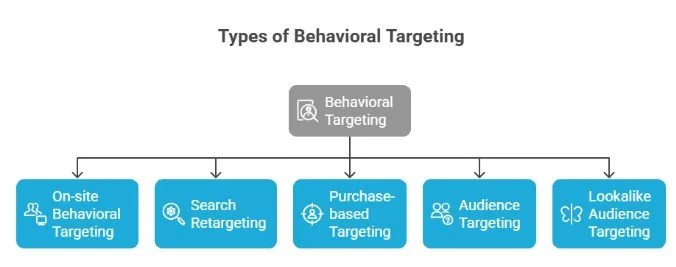
On-site behavioral targeting: This method tracks a user's behavior on a specific website. It analyzes actions like pages viewed, products added to the cart, search queries, and time spent on a page. Research shows that website visitors who see retargeted display ads are 70% more likely to convert.
Search retargeting: This method targets users based on the keywords they have searched for on search engines like Google or Bing. If a user searches for "best running shoes," they might later see ads for running shoes from various brands on different websites they visit. This indicates a high level of intent and makes search retargeting highly effective.
Purchase-based targeting: This type of targeting focuses on a user's past purchase history, both online and sometimes offline. A company might use this data to recommend related products, offer loyalty rewards, or show ads for items similar to those the user has already bought.
Audience targeting: This is a broader category that groups users into specific segments or "audiences" based on shared characteristics. These characteristics can include demographics, interests, lifestyle, or even psychographic data. For example, an audience segment might be "fitness enthusiasts" or "new parents.”.
Lookalike audience targeting: This is an advanced form of audience targeting where a company creates a new audience that "looks like" their existing high-value customers. The platform analyzes the common traits and behaviors of the existing customer base and then finds new users with similar characteristics to target with ads.
What Is Contextual Targeting and How It Works
Contextual targeting offers a privacy-compliant advertising solution that aligns ads with the content of a web page or media environment instead of relying on personal data or user behavior.
Here’s how it works: a crawler gathers information about a website to create ‘context.’ Based on this context, the ad server then matches the keywords of ads and content.
For example, when a user reads an article about running shoes, a smart contextual system might serve ads for fitness trackers or sports gear.
Instead of tracking individuals via third‑party cookies or their search history, contextual targeting analyzes page-level signals, such as keywords, topic clusters, semantics, and even tone via metadata, to deliver ads that feel native, timely, and relevant.
Leading ad tech platforms like Integral Ad Science (IAS) or programmatic DSPs scan content with AI-powered semantic analysis to determine relevant contexts and sentiment. These platforms let advertisers define context preferences, such as topic verticals, tone, seasonality, or specific keywords. Then, they bid via programmatic advertising platforms in real time to serve targeted placements.
These ads are less intrusive, safer for brands, and more relevant to users. According to a GumGum study, contextually relevant ads generate 43% more neural engagement, and users recall them 2.2 times better than traditional ads.
Contextual targeting may be seen as a type of behavioral advertising, except there’s no direct behavior tracking; instead, it predicts behavior based on contextual signals. It’s one of the biggest (and most successful) trends in programmatic advertising.
Behavioral Targeting vs. Contextual Targeting: Quick Comparison
The goals of behavioral vs. contextual ads are pretty much the same, and so are the metrics by which their success is measured (CTR, ROAS, conversion, CPA, etc.). However, several key differences make them very different from each other.
Pros & Cons of Behavioral and Contextual Ads: A Side-by-Side Comparison
If you work in digital advertising, media buying, or run a small business, you need to understand the trade-offs between behavioral and contextual targeting. That insight will help you pick the right approach for your campaigns.
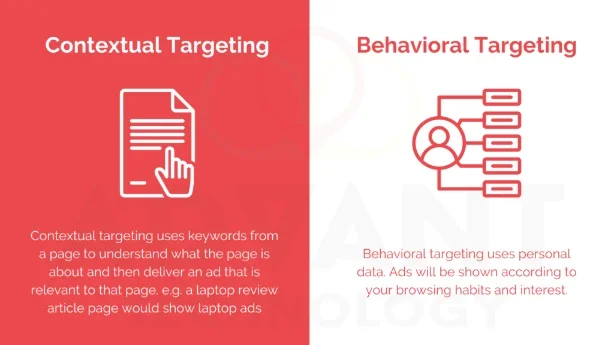
Let’s look at the benefits and drawbacks of each approach closely.
Behavioral Targeting Pros & Cons
Pros:
Highly personalized campaigns: Behavioral targeting allows granular control over ads, which results in personalized campaigns. Such a campaign, in turn, consistently delivers strong performance metrics. In fact, 52% of consumers say they’re more satisfied with personalized experiences.
High CTRs and ROI: Behavioral signals help advertisers target and retarget the right audience–those likely to click and convert. That means more click-throughs and conversions. Research suggests segmenting the audience based on behaviors can increase CTR by 670%.
Excellent for retargeting: Reminding users about products they browsed makes behavioral targeting particularly effective in customer journey stages where prior intent helps single out an audience likely to convert. This is all the more relevant for B2B campaigns and content that generally takes longer to convert a lead.
Better resource allocation: Segmenting the audience based on behavior can also help optimize ad budget spending. For example, higher bids may be set for high-value customers in cases where margins on offered products/services are different.
Cons:
Mounting privacy concerns: Modern consumers increasingly distrust how their personal data is used. In an S&P survey, 70% of respondents said they had concerns about privacy and data collection. Moreover, users are intentionally opting out of data collection/tracking and even using ad blockers. As a result, behavioral tracking via third‑party cookies is being phased out by browsers and regulators.
Compliance challenges with privacy regulations: This is an extension of the privacy dilemma. Government regulations are making it increasingly difficult for marketers and brands to collect and use data they typically use for behavioral targeting.
Contextual Targeting Pros & Cons
Pros:
Privacy-first approach: You don’t need cookies or personal tracking for this type of targeting. Ads are matched to content through keywords, semantics, and metadata, which aren’t specific to a person. So you’re not invading anyone’s privacy or breaking any regulations.
Relevant, targeted advertising with high ROI: Much like behavioral targeting, contextual ads, when done right, can deliver high CTRs and impressive ROI. For example, the Dutch public broadcaster NPO switched entirely to contextual ads and saw digital ad revenue increase by 62% and 79% in the months following that shift.
Improves user experience: The presentation of ads in an environment that’s contextually relevant delivers a better user experience, and naturally leads the audience to a product or service they’re highly likely to be interested in.
Better scalability in the cookieless future: As browsers and privacy regulations clamp down on behavioral tracking, contextual ads provide a viable way for audience segmentation and personalization without the use of cookies.
Cons:
Less personalized than behavioral targeting: Since it doesn’t use browsing or search history, ads may feel less tailored compared to behavioral targeting.
Effectiveness depends on the quality of website content: Weak or ambiguous content may lead to underperformance in matching ads and may reduce ad relevance or performance.
Challenges to Tackle: Legal & Privacy Concerns
Targeted advertising heavily relies on data. And data collection and sharing by companies is under great scrutiny, mainly because of privacy concerns. As of 2025, over 20 states in the U.S. have passed laws on data collection, processing, and sharing. The situation is the same everywhere, with 79% of the world population estimated to be protected by such laws.
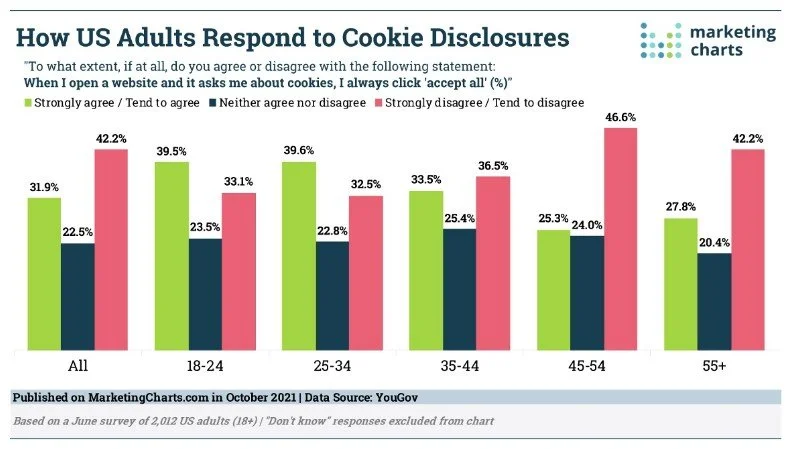
In the U.S., state-level privacy laws have different rules for opt-in vs opt-out consent, especially for sensitive data. This fragmented consent situation imposes operational complexity on advertisers who must adapt campaign setup, data flows, and compliance mechanisms for each jurisdiction. As the chart below shows, opt-outs are more common.
All these challenges are leading to what’s called compliance fatigue. And companies are clearly struggling to keep up with the regulations (or perhaps choosing not to).
A recent Consumer Reports test showed that even when users send automatic opt-out signals using tools like Global Privacy Control (GPC), some retailers still served behavioral ads, potentially violating laws like CCPA or Colorado privacy provisions. This exposes compliance gaps, reputational risks, and growing consumer distrust.
Speaking of consumers, behavioral targeting is leading to increased perceived privacy violations (PPV), according to a Columbia University research study. However, contextual targeting leads to lower PPV because it lacks precise targeting.
This shows that users online are becoming increasingly aware of not just when they’re targeted but how they’re targeted with ads. A highly personalized display based on their past searches or interests may backfire.
Meanwhile, large platforms are shifting toward gatekeeping models. Google’s Privacy Sandbox and Topics API replaced third-party cookies with cohort-based targeting. Yet independent studies warn these cohorts can still enable user re-identification, up to 75% in some cases, undermining anonymity.
Lastly, experts fear that contextual targeting may become more invasive as it grows more analytical with advanced technologies like machine learning. Some warn it could move closer to surveillance-based marketing
“New and evolving practices in contextual advertising should raise questions for policymakers. They should consider whether the harms we sought to avoid with behavioral marketing may resurface in these new advertising practices as well,” says Katharina Kopp, Privacy and Data Justice Advocate
Marketers will need to watch out for the regulations that directly impact behavioral marketing and PPV from both behavioral and contextual targeting.
Behavioral vs Contextual Ads? Why Hybrid Targeting Works Best
The most sophisticated advertisers aren’t choosing between behavioral or contextual targeting; they’re merging the two in hybrid strategies that optimize relevancy while respecting privacy. This balanced approach combines the targeting precision of behavioral data with the content-aware relevance of contextual targeting. That, in turn, delivers both efficiency and compliance.
Take, for example, a travel promotion campaign. Initially, contextual targeting identifies users currently browsing destination guides or travel blogs. That moment captures the consumer in mid‑decision.
Then, behavioral signals, such as users who previously added flights to their cart or engaged with travel apps, refine the audience into high-intent travelers. This creates a powerful synergy: context plus behavior delivering greater efficiency in ad delivery and conversions.
Why does this hybrid mix work?
Behavioral targeting gives you specificity and allows you to use first-party data (which you should be collecting as per regulations), retargeting, and enriched customer journey insights.
Contextual targeting ensures relevance to the moment and supports privacy regulations.
P.S. Want to put hybrid targeting into practice? Partnering with the Best Paid Media Agencies can help you design campaigns that combine both approaches for maximum impact.
When to Choose Behavioral or Contextual Ads
Although a hybrid approach can be great, there are instances where one type of targeting may outperforms the other. Contextual targeting is still expanding, while behavioral targeting continues to play a role. Knowing when to use each can give you a competitive edge.
Opt for Contextual Targeting When:
You're reaching new or anonymous audiences, especially when behavioral signals are limited or unavailable. Contextual ads deliver ads relevant to the web page’s content with meaningful placement even without past data.
Privacy concerns and regulations are priority number one. Contextual targeting works without using personal data, cookies, or tracking. It’s inherently privacy-friendly.
You want to capitalize on immediate relevance or trends. Contextual ads are perfectly suited for capturing intent in the moment, such as aligning ads with content on current events, seasonal topics, or trending stories.
Brand safety is a key concern. Modern contextual strategies, powered by AI, semantic targeting, and natural language processing, help ensure your ads appear in suitable, brand-aligned environments.
Lean into Behavioral Targeting When:
You have rich, consented first-party data, such as CRM records or onsite behavior. This enables audience targeting and retargeting campaigns that deliver personalized experiences and drive conversions. It does so without relying on third-party cookies, which are slowly being phased out
Your goal is repeat purchases or loyalty. Behavioral targeting excels at re-engaging users who've already interacted with your brand or shown purchase intent, whether via retargeting strategies or lifecycle segmentation.
You want personalization at scale. Campaigns tailored to past behaviors (e.g., cart abandoners, product page visitors) yield higher engagement, click‑through rates, and conversion rates. Research shows retargeted audiences are 43% more likely to convert than first timers.
If you want to maximize the power of behavioral targeting, working with the Best Retargeting and Remarketing Agencies can help you turn audience data into stronger campaigns.
Choose Wisely, Target Precisely
Both behavioral and contextual targeting have clear advantages. Behavioral has matured, with nearly all paid media channels enabling advertisers to use tracking data for refined targeting and personalized experiences. Contextual targeting, meanwhile, provides relevance without personal data.
Of course, targeting is only part of the equation. Conversion depends on ad quality, landing pages, and the overall brand experience.
When it comes to choosing between the two, you now have the insights to make an informed decision. In most cases, a blended approach works best. For specific campaigns, select the strategy that aligns with your goals and audience.
FAQs
What is the difference between contextual targeting and behavioral targeting?
Behavioral targeting relies on signals from user behavior, such as search history, site visits, and consumer behavior, to serve personalized ads. It depends on cookies, first-party data, and retargeting strategies.
Contextual targeting, in contrast, uses the content of the web page, including keywords, metadata, and semantic analysis, to match ads without tracking individuals or using personal data. It’s inherently more privacy-friendly.
What is an example of behavioral targeting?
If a user browses a pair of shoes on an eCommerce site, behavioral targeting systems, via retargeting pixels or audience segments, can then display ads for those shoes across other websites or platforms.
These ads may drive higher CTR and conversion rates, especially in campaigns targeting users who have already interacted with the brand or have purchase interest.
What is an example of contextual targeting?
Suppose someone is reading an article about cloud storage security; contextual targeting systems analyze the content and display ads for cloud backup services on that very website. This approach prioritizes relevance, brand safety, and user experience instead of tracking.
What are behavioral targets?
Behavioral targets are audience segments defined by patterns in user actions, such as purchase behavior, browsing habits, or app usage. Platforms like demand side platforms (DSPs) and data management platforms (DMPs) use these profiles to deliver tailored ad campaigns aimed at driving engagement and conversions.
What are the different targeting strategies in marketing?
The different targeting strategies in marketing include:
Behavioral targeting – Based on user actions and patterns.
Contextual targeting – Based on the current content environment.
Demographic targeting – Based on age, gender, location, and other attributes.
Geo-targeting – Matches ads to users in specific locations.
Retargeting – Re-engages users who've shown prior interest or intent.